The Dark Ages in Europe
Book of EstherThe Dark Ages in Europe are depicted as a centuries-long eclipse of learning whose eventual lifting prepared the way for the Reformation. In the book’s account, this was not merely a change in intellectual fortunes: the scarcity of books and widespread inability to read formed the historical background against which renewed learning, paper, and printing could serve the circulation of the Bible. The author treats both the darkness and its gradual reversal as part of God’s providential government, while presenting that interpretation as a theological claim rather than a neutral account of every cause of European history.
Extent and Character of the Darkness
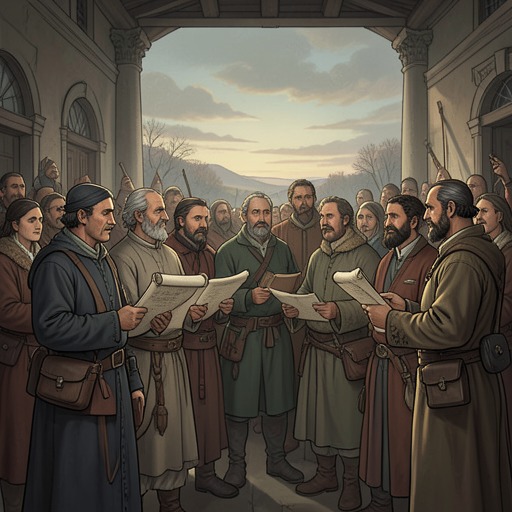
The account places the period of deepest decline from the seventh century to the end of the eleventh. It associates this darkness with the northern barbarians’ entry into the provinces of the Roman Empire, after which, in the author’s sweeping description, science and letters were extinguished and superstition and ignorance prevailed. The language is deliberately stark: Europe’s intellectual life is portrayed as having lost its force before beginning to recover.
The author gives illiteracy a central place in this picture. Citing Dr. Robertson, he describes learning as so limited that people of high rank and clergy in prominent positions could not necessarily read or write; some clergy, he says, struggled even with the breviary they were required to use. These examples make the period’s darkness concrete in the book’s argument: it was not simply a shortage of celebrated scholarship but a broad constraint on reading and access to written knowledge.
Scarcity of Books and the Limits of Reading
The book connects low literacy to the material difficulty of obtaining books. It recounts that Roman writing had used parchment and Egyptian papyrus, with papyrus generally the cheaper option. After the seventh-century conquest of Egypt by the Saracens disrupted communication between Egypt and Europe, papyrus could no longer be obtained in Europe, according to the account, leaving parchment as the writing material and making books scarce and costly. Existing parchment was sometimes reused after earlier writing had been erased, a sign of how valuable the material had become.
The author also points to later evidence of how slowly reading spread. He cites Lord Kames’s account that English law allowed a convicted murderer to avoid capital punishment if able to read, yet an edition of only six hundred English Bibles, translated in the reign of Henry VIII, took three years to sell. This example belongs to a later stage than the darkest centuries, but the book uses it to show how slowly literacy and Bible access advanced even after the initial revival of learning.
Revival, Paper, and Printing
In the author’s chronology, the human mind began to awaken in Europe toward the beginning of the twelfth century, and learning continued to advance through the sixteenth. He presents the invention of papermaking in the eleventh century as a crucial aid to this recovery and to the eventual spread of Scripture. The date is part of his providential interpretation: he argues that paper did not appear earlier because the world had been given over to darkness, and that its emergence helped foster the revival of literature and knowledge that later assisted the Reformation. A note in the text distinguishes the claimed date of the invention from the later establishment of paper as a general article of trade, addressing Lord Kames’s later dating of paper manufacture.
Paper alone, the author argues, could not make books broadly available while every copy still had to be written by hand. He describes printing as the next essential change: printing from wooden blocks is placed around 1420 in Germany or Flanders, with movable type developing about thirty years later. The art, in his account, reached a high degree of development in France within less than a century of its invention. He contrasts this capacity for multiplication with the earlier cost of manuscripts, noting that the expense of copying a Bible could rival the cost of building an ordinary country church. Together, paper and printing transformed the material prospects for Bible distribution, though the account presents widespread access as an emerging possibility rather than an instant result.
Providential Meaning and the Reformation
The book’s governing interpretation is that the return of learning prepared intellectual means for the Reformation. The author argues that literary revival and the Reformation shared both allies and opponents: learning could be misused against Christianity, but its proper pursuit helped expose error and support truth. He particularly claims that critical study of language and Scripture weakened defenses of the Church of Rome, which he portrays as relying on ignorance and restricting ordinary people’s access to the Bible. This is a polemical judgment within the book’s theological argument, not an impartial description of every aspect of that institution.
The author gives the timing of the revival a specific religious significance. He says God had determined to deal a mortal blow to the Man of Sin in 1517, and that the return of learning supplied, in the ordinary course of providence, the intellectual preparation for that purpose. In this image, scholarship becomes an instrument of conflict: the recovery of letters provides means for challenging superstition and interpreting Scripture, while printing helps distribute the resulting arguments. The Dark Ages thus function in the book not only as a period of deprivation but as the contrast that makes the providentially timed revival—and its contribution to the Reformation—central to the history of the Bible’s wider circulation.